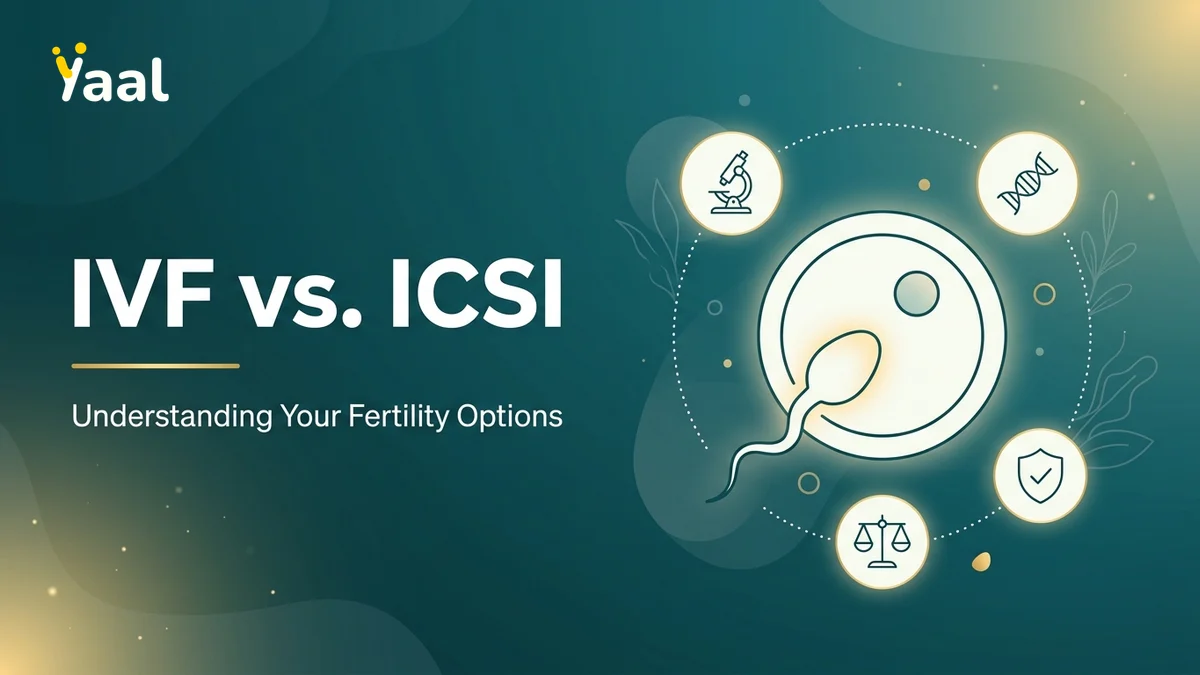
What is the Difference Between IVF and ICSI?
Both In Vitro Fertilization (IVF) and Intracytoplasmic Sperm Injection (ICSI) are highly advanced forms of Assisted Reproductive Technology (ART). They have revolutionized modern medicine, offering hope to millions of families worldwide. At their core, both procedures aim to achieve the same ultimate goal: the successful fertilization of an egg outside the human body, followed by the transfer of a healthy embryo into the uterus.
It is important to understand that ICSI is not an entirely different treatment from IVF; rather, it is a specialized variation of it. For the patient, the clinical journey is virtually identical — see our complete IVF process timeline for the full step-by-step walkthrough. Both options require the female partner to undergo ovarian stimulation using hormone medications to encourage the growth of multiple follicles.
Throughout this phase, regular ultrasound scans and blood tests monitor progress. Once the follicles reach the optimal size, a trigger injection is administered, followed by the egg retrieval procedure under light sedation. After fertilization occurs in the laboratory, the resulting embryos are cultured for a few days before being transferred back into the womb.
How Conventional IVF Works
In conventional IVF, the fertilization process mimics natural conception as closely as possible within a laboratory setting. After the eggs are retrieved and the semen sample is prepared, they are brought together in a specialized culture dish.
An embryologist places one egg alongside tens of thousands of active, moving sperm. The sperm must navigate this environment independently, bind to the outer layer of the egg (the zona pellucida), and naturally penetrate the egg's membrane to fertilize it. This method relies on the natural selection of the strongest, most motile sperm to complete the fertilization process without direct manual assistance.
How ICSI Fertilization Works
Intracytoplasmic Sperm Injection (ICSI) introduces a micro-manipulation technique to assist the fertilization process directly. Instead of leaving the sperm and egg to interact naturally in a dish, an embryologist takes an active, highly precise role.
Using an ultra-fine glass needle under a high-powered microscope, the embryologist isolates a single, structurally normal and active sperm cell. This individual sperm is then gently injected directly through the outer shell and into the cytoplasm (the inner core) of the mature egg. This direct physical introduction bypasses the need for the sperm to penetrate the egg's protective barriers on its own — see our detailed guide on how ICSI helps male infertility for more.
IVF vs ICSI: The Single Structural Difference in the Lab
To ease the anxiety surrounding these procedures, patients should know that the structural difference between conventional IVF and ICSI is confined entirely to a single step in the embryology laboratory. Outside of this specific laboratory event, there is no physical difference in how a patient experiences the treatment cycle.
| Step in Treatment Cycle | Conventional IVF | ICSI |
|---|---|---|
| Ovarian Stimulation | Hormonal injections to grow multiple eggs | Hormonal injections to grow multiple eggs |
| Monitoring & Scans | Regular ultrasounds and blood work | Regular ultrasounds and blood work |
| Egg Retrieval | Ultrasound-guided outpatient procedure | Ultrasound-guided outpatient procedure |
| Fertilization Method | Sperm and egg mix naturally in a dish | Single sperm is injected directly into the egg |
| Embryo Culture | Embryos monitored in incubator for 3–5 days | Embryos monitored in incubator for 3–5 days |
| Embryo Transfer | Selected embryo placed in the uterus | Selected embryo placed in the uterus |
During conventional IVF, approximately 50,000 to 100,000 washed, highly motile sperm are incubated with a single egg. This method allows natural chemical signals to guide the sperm, ensuring that only a sperm capable of breaking through the egg's outer membrane achieves fertilization.
With ICSI, the embryologist bypasses these natural physical barriers. This is particularly beneficial when the sperm lacks the physical capability to swim to the egg or penetrate its outer shell. Once this delicate injection is complete, the injected eggs are placed back into the incubator, and from that point forward, their development, monitoring, and transfer protocols are identical to those of conventional IVF.
When is ICSI Specifically Recommended Over Conventional IVF?

While conventional IVF is highly effective for many couples, ICSI is a specialized tool reserved for specific clinical situations. It is not a default upgrade for every cycle, but rather a targeted solution for distinct physiological challenges.
Male Factor Infertility Indicators
The most common indication for choosing ICSI over conventional IVF is male factor infertility. When semen parameters are significantly below normal ranges, conventional IVF may result in low or completely absent fertilization rates. Specific indicators include:
- Severe Oligozoospermia: An extremely low sperm count, making it statistically unlikely that enough active sperm will reach the egg in a dish.
- Asthenozoospermia: Poor sperm motility, where sperm lack the forward-progressive movement required to swim to and penetrate the egg.
- Teratozoospermia: Severe abnormalities in sperm morphology (shape), which can prevent the sperm from binding properly to the egg's outer shell.
Read our comprehensive guide to male factor infertility to understand exactly how these conditions are diagnosed.
Specialized Lab Requirements and PGT Cycles
Beyond standard male infertility, several specialized clinical scenarios make ICSI the preferred choice:
- Surgically Retrieved Sperm: If a man has a blockage or a non-obstructive condition preventing sperm release, sperm must be retrieved directly from the testicles or epididymis using procedures like TESA or Micro-TESE. Because these surgically retrieved sperm are immature and limited in number and motility, ICSI is required to achieve fertilization.
- Frozen Sperm Samples: Cryopreserved sperm, especially samples with low pre-freeze quality or those obtained from oncology patients prior to cancer therapy, benefit from ICSI because the thawing process can reduce sperm motility.
- Preimplantation Genetic Testing (PGT): When embryos need to undergo genetic screening for chromosomal abnormalities or hereditary disorders, ICSI is performed. This prevents "paternal contamination," ensuring that no residual sperm sticking to the outside of the egg shell interfere with the highly sensitive genetic analysis.
- Prior Fertilization Failure: If a couple previously underwent a conventional IVF cycle that resulted in poor or zero fertilization despite seemingly normal parameters, ICSI is utilized in subsequent cycles to overcome unexplained fertilization barriers.
Comparing Success Rates: ICSI vs Conventional IVF
A frequent source of anxiety for couples is whether opting for conventional IVF over ICSI—or vice versa—will compromise their chances of achieving a successful pregnancy. It is a common misconception that because ICSI is more technically complex, it automatically yields higher overall pregnancy and live birth rates for everyone.
Medical research consistently demonstrates that when male factor infertility is not present, the success rates of conventional IVF and ICSI are statistically equivalent. ICSI is designed to address the specific hurdle of fertilization. Once fertilization has successfully occurred, an embryo created via ICSI has the same implantation potential, developmental trajectory, and live-birth probability as an embryo created through conventional IVF — see our ICSI success rates guide for more detail on what drives outcomes.
Ultimately, the success of any assisted reproductive cycle is heavily influenced by factors that go beyond the laboratory fertilization method:
- Maternal Age: Egg quality naturally declines with age, which affects the genetic health of the embryo and its ability to implant — see our IVF success rate by age guide.
- Ovarian Reserve: The quality and quantity of retrieved eggs play a foundational role in producing viable blastocysts.
- Endometrial Receptivity: The health and preparation of the uterine lining are crucial for successful embryo implantation.
- Lifestyle and Overall Health: Factors such as body mass index (BMI), stress levels, and systemic health conditions influence overall outcomes.
Therefore, choosing ICSI is about overcoming specific physical barriers to fertilization, rather than artificially boosting the baseline developmental potential of the embryo.
Understanding the Cost Difference Between IVF and ICSI
When evaluating treatment paths, understanding the financial investment is essential for realistic planning. ICSI generally carries a higher cost than conventional IVF. This price difference is directly linked to the advanced technology, specialized infrastructure, and laboratory expertise required to perform the procedure.
The primary drivers of the cost difference include:
- Specialized Micro-manipulation Equipment: ICSI requires highly sophisticated microscopes equipped with robotic micromanipulators, micro-injectors, and specialized vibration-dampening tables. Maintaining this high-precision hardware demands significant ongoing investment.
- Consumables and Micro-tools: Every individual egg injected requires dedicated, single-use glass micro-needles (holding pipettes and injection pipettes) manufactured to exacting standards.
- Embryologist Expertise and Time: Unlike conventional IVF, where sperm and eggs are combined and left to incubate, ICSI requires an experienced embryologist to manually select, stabilize, and inject each mature egg one by one. This labor-intensive process demands years of specialized training and absolute precision.
Rather than looking for a fixed flat rate, patients should view this as a directional cost difference. The overall investment for any fertility cycle is highly individualized, depending on the dosage of stimulation medications required, the need for additional techniques like blastocyst culture or genetic testing, and whether frozen embryo transfers are planned — see our IUI vs IVF cost comparison for a similar breakdown of cost drivers.
How Your Fertility Doctor Decides Which Treatment You Need
The decision to proceed with conventional IVF or ICSI is never arbitrary. It is a highly tailored clinical choice guided by diagnostic testing, medical history, and real-time laboratory observations.
The diagnostic journey begins with a comprehensive semen analysis, which evaluates sperm count, motility, and morphology. If these parameters show significant deficits, the recommendation will lean strongly toward ICSI.
However, fertility specialists also consider the couple's history, including any unexplained infertility, previous cycle outcomes, and the female partner's age. On the day of egg retrieval, the final decision is refined based on the number and maturity of the retrieved eggs. Because only fully mature eggs can undergo ICSI, the embryologist evaluates the quality of the gametes before finalizing the laboratory protocol.
In borderline cases, where semen parameters are mildly abnormal or the cause of infertility remains unexplained, a "split IVF-ICSI" approach may be recommended. In a split cycle, half of the retrieved eggs are subjected to conventional IVF, while the other half undergo ICSI. This approach serves as both a therapeutic treatment and a valuable diagnostic tool, providing clear insights into how the sperm and eggs interact while safeguarding the cycle against unexpected fertilization failure.
Consulting a Fertility Specialist in Chennai for Personalized Care
For couples seeking fertility care in Southern India, local access to advanced reproductive laboratories is a key factor in their journey. At Yaal Fertility Centre, located in Chennai, Tamil Nadu, we provide a warm, reassuring environment designed to ease the stress of fertility treatments.
Led by Dr. Rukkayal Fathima, MRCOG (UK), our medical team focuses on clear, evidence-based guidance. We understand that every couple's path is unique, and we prioritize thorough diagnostic assessments to determine whether conventional IVF or ICSI is the most appropriate, cost-effective choice for your specific situation.
Yaal Fertility Centre combines advanced laboratory infrastructure with a highly skilled embryology team. By tailoring our diagnostic protocols to the specific needs of South Asian couples, we ensure that you receive clear, personalized recommendations without unnecessary procedures.
If you are ready to explore your options and gain a clear understanding of the best path forward for your family, we invite you to take the next step.
Book an appointment with Yaal Fertility Centre.
Frequently Asked Questions About ICSI vs IVF
Is ICSI safer than conventional IVF?
Both conventional IVF and ICSI are considered highly safe medical procedures with millions of healthy children born worldwide through both techniques. The primary health considerations for the mother, such as the risk of Ovarian Hyperstimulation Syndrome (OHSS) or multiple pregnancies, are related to the ovarian stimulation and embryo transfer stages, which are identical in both procedures.
Does ICSI increase the risk of birth defects?
Studies indicate a very slight increase in the risk of minor congenital anomalies or sex chromosome abnormalities associated with ICSI (approximately 1% to 2% higher than natural conceptions). However, fertility specialists generally attribute this minor increase to the underlying parental infertility factors (such as severe male factor infertility) that necessitated the use of ICSI in the first place, rather than the micro-injection procedure itself.
Is the physical recovery different for an ICSI cycle?
No, the physical recovery for the patient is exactly the same. Because the only difference between IVF and ICSI takes place inside the embryology laboratory, the patient's physical experience—including the medication side effects, the egg retrieval recovery, and the post-embryo transfer care—remains completely identical.
Can ICSI be used if there is no sperm in the ejaculate?
Yes. In cases of obstructive or non-obstructive azoospermia (zero sperm in the semen), sperm can often be retrieved directly from the testicular tissue using advanced surgical extraction techniques like TESA or Micro-TESE. Because these retrieved sperm are few in number and cannot swim effectively, ICSI is the only method that can be used to fertilize the eggs.
Frequently Asked Questions
Written by
Dr. Rukkayal Fathima
Specialist at Yaal Fertility Centre, Chennai. Providing expert guidance on fertility and women's health.