
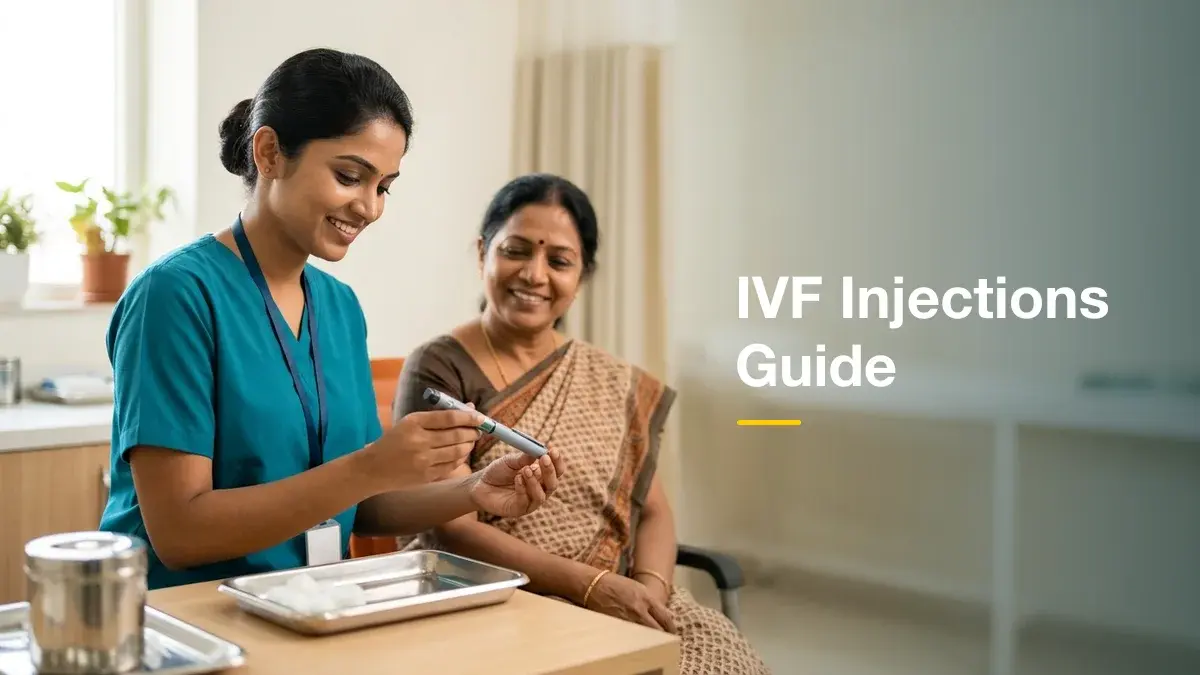
Starting IVF can feel exciting and overwhelming, especially when it means giving yourself daily injections. Understanding how IVF injections work and what to expect can reduce anxiety and help you feel in control. This guide covers the main types, the trigger shot, how injections are given, ways to reduce discomfort, storage, side effects and warning signs. It is general information. Always follow the exact protocol your own doctor gives you. At Yaal Fertility Centre in Chennai, Dr. Rukkayal Fathima and the team take every IVF patient through their injection schedule before stimulation starts.
What Are IVF Injections and Why Are They Necessary?
In a natural cycle, your body recruits several follicles but usually only one matures and releases an egg. IVF aims for several mature eggs to allow for the natural losses at fertilisation, embryo development and genetic screening.
Injectable hormones override the body's natural limit, stimulating the ovaries to develop several follicles at once. They also let your doctor control the timeline. Scans and blood tests show how the follicles are growing, so doses can be adjusted and eggs collected at the right moment.
Oral medicines such as clomiphene or letrozole work indirectly through the brain and are common in simpler treatment such as IUI. Injectable gonadotropins act directly on the ovaries, which is why they are used to obtain the higher yield needed for IVF. See our IVF process guide.
The Main Types of IVF Injections and What They Do
An IVF cycle uses different medicines at different times. Protocols are individual, and no two patients get exactly the same doses.
Gonadotropins for Ovarian Stimulation (FSH and hMG)
Stimulation usually starts on day 2 or 3 of the cycle and lasts about 8 to 12 days, with daily injections of:
- Recombinant FSH (follicle-stimulating hormone): made in a laboratory, it mimics your natural FSH and encourages several follicles to grow.
- Human menopausal gonadotropin (hMG): contains both FSH and LH (luteinising hormone), which supports the later stages of follicle development.
GnRH Antagonists and Agonists to Prevent Premature Ovulation
As follicles grow, rising estrogen can trigger an LH surge and premature ovulation, which would ruin the cycle because the eggs would be released before collection. To prevent this, a second medicine is added:
- GnRH antagonists are usually started midway through stimulation and quickly block the LH surge.
- GnRH agonists may be used in some protocols, sometimes starting in the previous cycle, to suppress the pituitary before stimulation.
The Critical Role of the Trigger Shot in Your IVF Cycle
The trigger shot is a single, precisely timed injection at the end of stimulation. When scans show enough follicles have reached a suitable size, you stop the daily injections and take the trigger.
It starts the final maturation of the eggs and loosens them from the follicle wall so they can be collected. The timing is usually about 34 to 36 hours before egg retrieval. For example, if retrieval is at 8 am on Wednesday, the trigger would be around 8 to 9 pm on Monday.
If it is taken too early, eggs may be released before retrieval; too late, and they may not be mature enough to collect. If you make a timing mistake, even a small one, call your clinic straight away, because the retrieval time can sometimes be adjusted. See our egg retrieval guide.
How to Administer IVF Injections: A Step-by-Step Guide
Your clinic will show you how to give injections at a teaching session. What follows is a general overview only.
Preparing Your Injection Site and Equipment
- Use a clean, well-lit surface and wash your hands with soap and water for at least 20 seconds.
- Gather the medicine (vial or pre-filled pen), needles, alcohol swabs, gauze and a sharps container.
- Check the label, dose and expiry date.
- If the medicine needs mixing, follow your clinic's instructions and make sure there are no air bubbles.
Step-by-Step Subcutaneous Injection Technique
Most stimulation medicines go just under the skin (subcutaneous), where there are fewer nerve endings, so it is generally the least painful method.
- Choose and clean the site. The abdomen (at least two inches from the navel) or front of the thigh. Wipe with an alcohol swab and let it dry fully.
- Pinch the skin. Gently lift a fold of skin and fat.
- Insert the needle. Quickly and smoothly, usually at 90 degrees (45 degrees if you have little body fat), as your clinic has shown you.
- Inject slowly. Press the plunger steadily until it is empty, then pause a few seconds.
- Withdraw and press. Pull the needle out at the same angle and press gauze on the site without rubbing. Put the needle straight into the sharps container.
Some medicines, such as progesterone in oil used after retrieval and transfer, are given into the muscle (usually the upper buttock) with a longer needle, and are easier for a partner to give. Our progesterone injection guide covers these in detail.
Essential Tips to Reduce Pain and Bruising from IVF Injections
- Let refrigerated medicine warm up. Take it out for 15 to 20 minutes before use, since cold liquid can sting. Do not heat it artificially.
- Use cold and warm compresses. A wrapped ice pack for a few minutes can numb the skin before a subcutaneous injection. After an intramuscular injection, a warm compress helps the oil disperse and reduces lumps.
- Rotate sites. Use a different spot each day, keeping an inch or so from the last, and avoid areas that are already bruised or tender.
Safe Storage and Temperature Rules for IVF Medications
Fertility medicines are sensitive biological products. Always follow the storage instructions on the box and from your clinic, because they differ between brands. In general:
| Medicine type | Typical storage | Precautions |
|---|---|---|
| Unmixed gonadotropins | Often refrigerated (2–8 °C), or as labelled | Do not freeze; keep in the original box away from light |
| Antagonists | As labelled | Protect from sunlight and heat |
| Progesterone in oil | Room temperature | Do not refrigerate; cold can make the oil crystallise |
When carrying medicine, use an insulated bag with ice packs, but do not let the medicine touch the ice directly, so it does not freeze. Store refrigerated items on a middle shelf, not in the door. Put used needles in a puncture-proof sharps container and dispose of it properly or return it to your clinic. Never put needles in household rubbish.
Understanding Common IVF Injection Side Effects
Mild local effects such as redness, itching, small bruises or slight swelling at the injection site are common and usually fade within hours.
As estrogen rises, you may notice:
- Bloating and pelvic fullness: the ovaries enlarge as follicles grow.
- Mood swings and irritability: similar to strong PMS.
- Breast tenderness and mild headaches.
These are usually temporary and settle within a few days of egg retrieval.
Recognizing the Warning Signs of Ovarian Hyperstimulation Syndrome (OHSS)
In a small number of patients the ovaries overreact to stimulation, especially after the trigger. In OHSS, blood vessels become leaky and fluid shifts into the abdomen and sometimes the chest. See our detailed guide on OHSS symptoms and prevention.
Mild to Moderate OHSS Symptoms
- mild to moderate abdominal discomfort or cramping;
- noticeable bloating;
- mild nausea, vomiting or diarrhoea;
- gradual weight gain over several days.
Severe OHSS Symptoms (Seek Medical Help Immediately)
- rapid weight gain (for example more than 1 kg in 24 hours);
- severe, persistent abdominal pain;
- vomiting that stops you keeping fluids down;
- shortness of breath, especially when lying flat;
- passing very little urine.
Contact your clinic straight away if you have any of these. Severe OHSS needs close monitoring and treatment.
What to Ask Your Fertility Clinic About Your Injection Protocol
Your clinic should offer an injection teaching session. Good questions to ask:
- Can you take me through the dose and timing of each medicine on my schedule?
- Who do I call, and on what number, if I make a mistake out of hours?
- What should I do if a delivery is delayed or I break a vial?
- If I miss a dose or take it late, how long do I have before I must tell you?
- Can a nurse watch me give my first injection?
Save your clinic's emergency number in your phone before you start.
IVF Treatment and Medication Support in Chennai
Daily injections need logistics as well as courage: cold-chain storage, regular scans and blood tests every few days, and quick dose changes. Choosing a clinic that is easy to reach and offers guidance and support during stimulation makes this much less stressful. If you are not comfortable giving injections yourself, ask your clinic what support they can arrange. Our guide to IVF cost in Chennai explains what a cycle typically includes.
Having IVF at Yaal. Yaal has on-site embryology labs at four centres: Kilpauk in Central Chennai, Thiruvanmiyur for Adyar, Besant Nagar and the ECR belt, Velappanchavadi for Porur, Poonamallee and West Chennai, and Tambaram for Chromepet, Selaiyur and Perungalathur. Cycle-tracking scans are available at all eight Yaal centres.
Frequently Asked Questions About IVF Injections
Are IVF injections painful?
Most people describe subcutaneous injections as a mild pinch or sting, since the needles are very thin. Intramuscular injections can leave deeper soreness, which a warm compress and gentle massage can ease.
What happens if I miss an injection by an hour?
For many daily stimulation medicines a small delay is often acceptable, but aim for the same time daily and tell your clinic. For antagonists and especially the trigger, timing is strict, so report any delay, even 30 minutes, straight away.
Do IVF injections cause long-term health risks or early menopause?
Current evidence does not show that IVF injections deplete your ovarian reserve or cause early menopause. They recruit eggs your body would otherwise have lost in that cycle. If you have specific concerns, discuss them with your doctor.
Can I travel with my IVF medications?
Yes, but keep the cold chain for refrigerated products, carry a doctor's letter, and keep medicines in your hand luggage. Check with your clinic before you travel.
How many days of IVF injections will I need?
Daily stimulation injections usually run for about 8 to 12 days, followed by a single trigger shot. Your exact number of days depends on how your follicles respond on the monitoring scans.
Can my partner give my IVF injections?
Yes. Many couples share the task, and a partner often finds intramuscular progesterone easier to give than you would yourself. Ask your clinic to teach both of you at the injection session.
Partnering with Yaal Fertility Centre for Your IVF Journey
At Yaal Fertility Centre in Chennai, Dr. Rukkayal Fathima, MRCOG (UK), and our team plan your injection protocol, teach you to give each shot, and adjust doses from your monitoring scans so the trigger lands at the right time. Stimulation scans and injection support are available at all eight centres, so you can stay close to home for the frequent visits: Kilpauk, Mylapore, Thiruvanmiyur, Pallikaranai, Madipakkam, Red Hills, Velappanchavadi and Tambaram. Egg collection itself happens at the IVF-lab centres in Kilpauk, Thiruvanmiyur, Velappanchavadi and Tambaram. Learn more on our IVF treatment page, or call us on +91 75500 06704.
Written by
Dr. Rukkayal Fathima
Specialist at Yaal Fertility Centre, Chennai. Providing expert guidance on fertility and women's health.