A consanguineous marriage is a marriage between two people who are related by blood, such as first cousins or a maternal uncle and niece. These marriages are a long-standing tradition in Tamil Nadu and across South India. The reassuring fact is that most children of related couples are born healthy. The risk of certain inherited conditions is higher, though, and simple carrier screening and genetic counselling before marriage or pregnancy let a couple plan with confidence. At Yaal Fertility Centre in Chennai, Dr. Rukkayal Fathima and our team see many related couples, and the aim is always informed planning, never judgement.
What Is a Consanguineous Marriage?
To define consanguineous marriage simply: it is a union between two partners who share at least one common ancestor. In medical genetics, couples related as second cousins or closer are usually described as consanguineous.
How Much DNA Do Related Partners Share?
The closer the relationship, the more genes the partners are likely to share from their common ancestors:
| Relationship | Degree of relationship | Genes shared (approx.) |
|---|---|---|
| Uncle and niece | Second-degree relatives | 1 in 4 (25%) |
| First cousins | Third-degree relatives | 1 in 8 (12.5%) |
| Second cousins | Fifth-degree relatives | 1 in 32 (about 3%) |
In Tamil Nadu, maternal uncle–niece and first-cousin marriages have been common for generations. Medical advice does not question these customs; it gives couples accurate information so they can protect their future children's health.
Consanguineous Marriage in Tamil Nadu and South India
Marriage within the family has a long history in South India, and Tamil Nadu has traditionally had one of the higher rates in the country. Families often value it because the couple and their parents already know and trust each other, it keeps relatives close, and it can make practical matters such as property and support in old age simpler. In cities, and as more young people meet partners through education and work, these marriages have become less common, but they remain an accepted choice for many families.
From a doctor's point of view, none of this is a problem to be solved. It simply means that related couples benefit from a few extra checks, done early and calmly, so that any risk is known before a pregnancy rather than discovered after a child is born.
Cross-Cousin and Parallel-Cousin Marriage
In South India, the traditional preference is usually for cross-cousin marriage, for example marrying the child of your father's sister or your mother's brother. A parallel-cousin marriage is between the children of two brothers or two sisters. Families sometimes believe one type is genetically safer than the other, but genetically, all first cousins share about the same proportion of genes. What matters medically is how closely you are related, not which side of the family the relationship comes from.
When the Relationship Is Repeated Over Generations
The table above assumes a single relationship. In some families, marriages within the family have happened in several generations, so a couple may be related in more than one way, for example as first cousins whose parents were also cousins. In that case they may share more genes than the table suggests, and the chance of both carrying the same recessive gene is higher. This is why your doctor will ask about your parents' and grandparents' relationships, not just your own.
Non-Consanguineous Marriage and Related Terms
- Non-consanguineous marriage: a marriage between partners who are not related by blood. In Tamil, a consanguineous marriage is called இரத்த உறவுத் திருமணம், or in everyday speech சொந்தத்தில் திருமணம் (marrying within the family), and a non-consanguineous marriage is இரத்த உறவு இல்லாத திருமணம்.
- "Consanguineous marriage of parents" on a medical form: the doctor is asking whether your own parents are related by blood. Answer yes or no; it helps the team judge the chance of an inherited condition.
- Consanguinity: the medical word for being related by blood. A consanguineous couple is a couple who share a common ancestor.
- "Contagious marriage" or "congenital marriage": these are common mix-ups. Consanguineous has nothing to do with infection (contagious) or with conditions present at birth (congenital); it only describes a blood relationship.
Why Does the Genetic Risk Increase?
The extra risk comes mainly from autosomal recessive conditions.
Everyone carries two copies of each gene, one from each parent. Most of us also carry a few altered genes without knowing it, because the second, working copy keeps us healthy. A person like this is a carrier.
Why Related Couples Are More Likely to Share a Carrier Gene
Because related partners share recent ancestors, they are more likely to have inherited the same altered gene. When both partners carry the same one, each pregnancy has:
- A 1 in 4 chance that the child inherits both altered copies and is affected.
- A 1 in 2 chance that the child is a healthy carrier, like the parents.
- A 1 in 4 chance that the child inherits neither altered copy.
How Big Is the Risk, Really?
In any pregnancy, the background chance of a serious birth defect or genetic condition is about 2–3%. For first-cousin couples, it rises by roughly another 2–3%, to about 4–6%. Put the other way, about 94–96% of children born to first-cousin couples are healthy. The risk is higher for closer relationships (such as uncle–niece) and for families where a condition is already known.
Diseases Associated With Consanguineous Marriages
The conditions seen more often in children of related couples are mostly recessive:
- Thalassaemia and other haemoglobin disorders, including sickle cell disease. These are among the most common and the easiest to screen for. See our guide to the thalassemia test before marriage.
- Congenital hearing loss, often caused by recessive genes such as GJB2.
- Inborn errors of metabolism, such as phenylketonuria (PKU), in which the body cannot process certain nutrients.
- Neuromuscular conditions, such as spinal muscular atrophy (SMA).
- Some forms of intellectual disability and other rare inherited conditions.
Family history is the most useful clue. A known condition, an unexplained childhood illness or an early childhood death in either family should always be mentioned to your doctor. A family with no known history can still carry a recessive gene silently, which is why basic screening is worthwhile for every related couple.
Does Consanguinity Affect Fertility or Miscarriage?
The evidence shows that being related does not, by itself, lower a couple's fertility. Most related couples conceive without difficulty.
When both partners carry the same serious recessive gene, an affected pregnancy may occasionally end in early miscarriage. If you have had two or more miscarriages, both partners should be evaluated together, looking at genetic, hormonal and uterine factors. Read more about recurrent pregnancy loss and how it is investigated.
Being related is also not, by itself, a reason to need IVF. Related couples who are both healthy, with no known shared condition, can try to conceive naturally. IVF with embryo testing is only suggested when screening shows a specific shared risk, or when there is a separate fertility problem.
Before Pregnancy: Carrier Screening and Genetic Counselling
A few practical steps before marriage or a first pregnancy turn uncertainty into a clear plan.
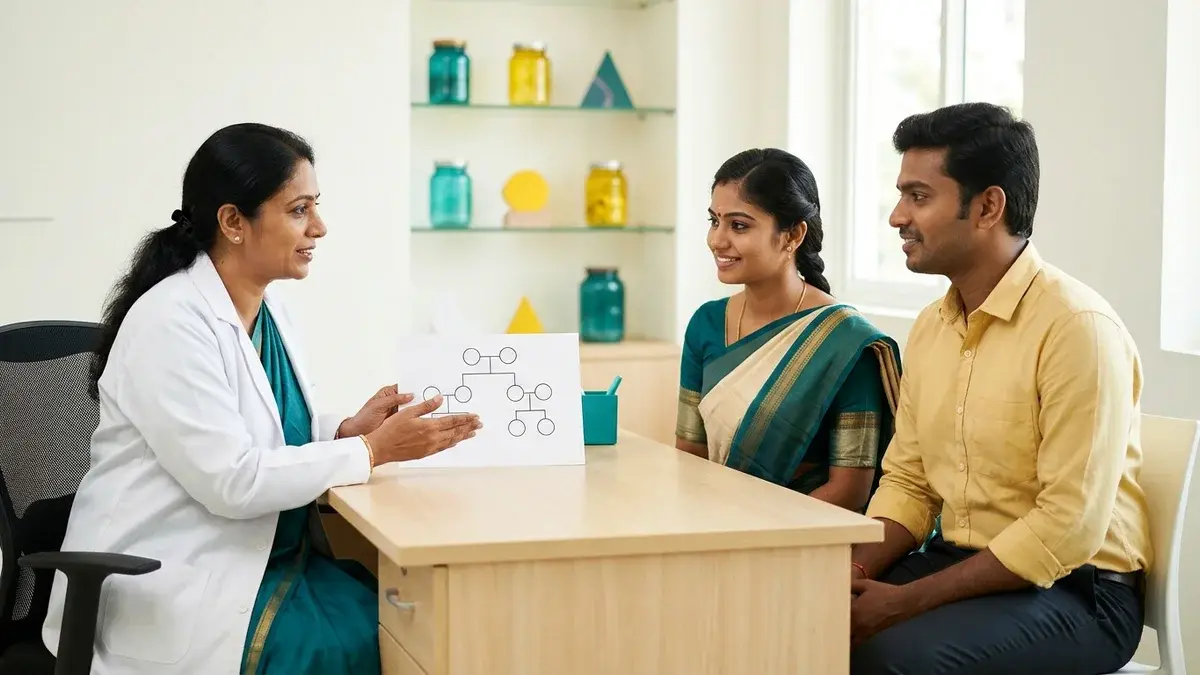
- Family history: a three-generation family tree that notes known conditions, childhood illnesses or early deaths.
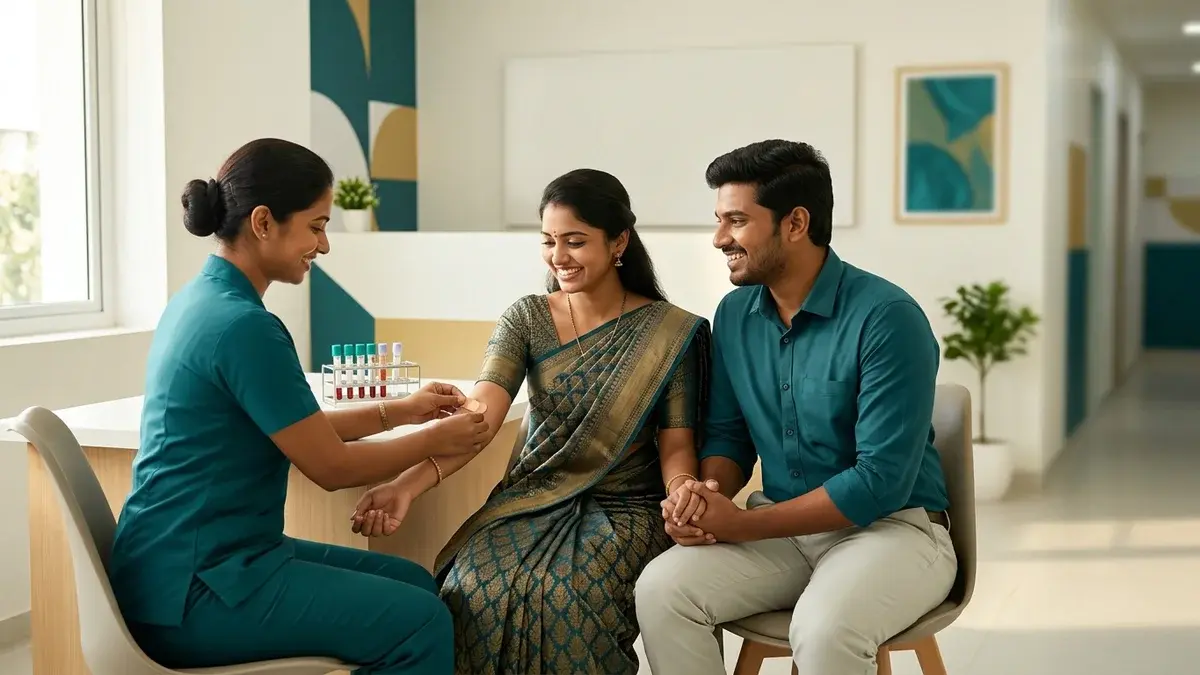
- Basic blood tests: a complete blood count and haemoglobin HPLC to check for thalassaemia and other haemoglobin variants, as part of a premarital health checkup.
- Targeted or expanded carrier screening: where a specific condition runs in the family, or the couple wants broader reassurance, DNA tests can check one gene or hundreds at once. Your doctor will advise whether this is useful for you. Our guide to carrier screening for couples explains the two kinds of test.
- Genetic counselling: a specialist explains your results, your actual risk and your options.
Genetic counselling is a calm, private conversation. Its purpose is to give you facts and choices, not to judge your marriage. You might also want to read about blood group compatibility for marriage.
What a Carrier Screening Report Tells You
A carrier screening report lists whether each partner carries an altered copy of the genes tested. What matters is the couple's result together, not each person's on their own.
| Your combined result | What it means for a pregnancy | Usual next step |
|---|---|---|
| Neither partner is a carrier for the conditions tested | Risk for those conditions is very low | No extra action for those conditions; routine antenatal care |
| One partner is a carrier | Children cannot inherit two altered copies of that gene, so they will not have that recessive condition, though some may be healthy carriers | Usually no change to pregnancy plans; relatives may wish to be tested |
| Both partners carry altered copies of different genes | Each condition needs two altered copies of the same gene, so the risk stays low | Counselling to confirm, then routine care |
| Both partners carry the same condition | Each pregnancy has a 1 in 4 chance of an affected child | Genetic counselling and a discussion of options such as PGT-M or prenatal diagnosis |
| A "variant of uncertain significance" | The lab found a gene change whose effect is not yet known | Your doctor or genetic counsellor explains whether it changes anything; most do not |
No screening test covers every possible condition, so a "negative" report lowers the risk a great deal but cannot remove it completely. A good counsellor will explain exactly which conditions were tested.
A Step-by-Step Plan for Related Couples
- Before marriage or soon after: share family history openly with each other, and book a premarital health checkup that includes a blood count and haemoglobin HPLC. See also fertility tests before marriage.
- Before trying for a baby: see a doctor for preconception care. Start folic acid before pregnancy, review any medicines, and decide with your doctor whether targeted or expanded carrier screening is worthwhile for you.
- If both of you carry the same condition: meet a genetic counsellor to understand the condition and your options before pregnancy, when you have the most choices.
- During pregnancy: tell your obstetrician that you are related. You will usually be offered a detailed anomaly scan, and prenatal testing if a specific risk is known.
- After birth: make sure your baby has newborn screening, and tell the paediatrician that you are related so any early signs are checked promptly.
Following these steps does not mean expecting a problem. For most related couples, the tests come back reassuring and the pregnancy is planned exactly like any other.
Options When Both Partners Carry the Same Condition
If both partners are found to carry the same condition, there are established ways to have a healthy child.
IVF with PGT-M
Preimplantation genetic testing for monogenic disorders (PGT-M) is done during an IVF cycle. A few cells are taken from each embryo and tested for the couple's specific gene change, and only an unaffected embryo is transferred. Read more about genetic testing of embryos or our complete guide to PGT.
Prenatal Diagnosis
Couples who conceive naturally can have the baby tested early in pregnancy by chorionic villus sampling (CVS) at about 10–13 weeks or amniocentesis at about 15–20 weeks, followed by counselling on the results.
Donor Eggs or Sperm
Using eggs or sperm from a donor who is not a carrier removes the risk of the child inheriting two altered copies. This is offered through donor egg and sperm IVF.
Pregnancy and Newborn Care for Related Couples
Related couples benefit from careful antenatal care, including a detailed anomaly scan, and routine newborn screening after birth. Where a pregnancy has specific risks, our high-risk pregnancy care team provides closer monitoring.
Newborn screening is a simple heel-prick blood test taken in the first days of life. It checks for a number of treatable conditions, including some inherited metabolic and thyroid disorders, before symptoms appear. For babies of related parents it is especially worthwhile, because early diagnosis of many of these conditions allows treatment, such as a special diet or medicine, to start straight away. Ask your hospital which conditions its screening covers, and whether extended screening is available.
Myths and Facts About Consanguineous Marriage
| Myth | Fact |
|---|---|
| "Children of cousins are always unhealthy." | About 94–96% of children of first-cousin couples are healthy. |
| "Our families have no illness, so we are safe." | Carriers have no symptoms, so a recessive gene can pass silently for generations. |
| "Cross-cousin marriage carries no genetic risk." | All first cousins share about the same proportion of genes, whichever side of the family. |
| "Related couples cannot conceive easily." | Being related does not lower fertility by itself. |
| "If our first child is healthy, the next will be too." | The chance is the same in every pregnancy; one healthy child does not change it. |
| "Nothing can be done if we are both carriers." | Options such as IVF with PGT-M, prenatal diagnosis and donor eggs or sperm allow carrier couples to have unaffected children. |
Frequently Asked Questions About Consanguineous Marriage
What is a consanguineous marriage in simple words?
It is a marriage between two people who are related by blood because they share a common ancestor, such as first cousins or an uncle and niece.
Is it safe to marry a blood relative?
Most children of related couples are healthy. The chance of a serious genetic condition or birth defect rises from about 2–3% to about 4–6% for first cousins, and carrier screening before pregnancy can identify specific risks so they can be planned for.
What are the chances of having a healthy baby?
For first-cousin couples, about 94–96% of babies are healthy. If screening shows both partners carry the same condition, options such as IVF with PGT-M or prenatal diagnosis can make sure the baby is not affected.
Should we get tested if no one in our family has a genetic condition?
Yes, basic screening is still worthwhile. Carriers have no symptoms, so a recessive gene can pass silently through generations before two carriers have a child together.
Is consanguineous marriage legal in India?
It depends on the personal law that applies to the couple. The Hindu Marriage Act prohibits marriages within certain degrees of relationship unless a custom permits them, and such customs are recognised in parts of South India. Muslim personal law permits cousin marriage. For legal questions, consult a lawyer; your doctor's role is your health.
What is the difference between consanguineous and non-consanguineous marriage?
In a consanguineous marriage the partners share a recent common ancestor, such as a grandparent. In a non-consanguineous marriage they are not related by blood.
What does "consanguineous marriage of parents" mean on a hospital form?
It asks whether your parents are blood relatives, for example cousins or uncle and niece. Doctors use the answer to judge the chance of inherited recessive conditions.
What are the main health risks for children of related parents?
Mainly recessive conditions: thalassaemia and other haemoglobin disorders, congenital hearing loss, metabolic disorders, neuromuscular conditions such as SMA, and some rare inherited conditions.
Premarital Screening and Genetic Counselling at Yaal Fertility Centre, Chennai
Yaal Fertility Centre offers confidential, non-judgemental care for related couples planning marriage or a family. Led by Dr. Rukkayal Fathima, MRCOG (UK), Founder and Director, with more than 15 years of experience in obstetrics, gynaecology and reproductive medicine, our team provides premarital health checkups, haemoglobin HPLC carrier screening, genetic counselling and, where needed, IVF with PGT-M.
Premarital screening at Yaal. You can give samples for a premarital checkup at any of our eight centres across Chennai: Kilpauk, Mylapore, Thiruvanmiyur, Pallikaranai, Madipakkam, Red Hills, Velappanchavadi and Tambaram. Every centre has a private counselling room, so you can go through your results with Dr. Rukkayal Fathima's team close to home.
If you are related to your partner and want to understand your risk before marriage or pregnancy, book an appointment with Yaal Fertility Centre.
Written by
Dr. Rukkayal Fathima
Specialist at Yaal Fertility Centre, Chennai. Providing expert guidance on fertility and women's health.