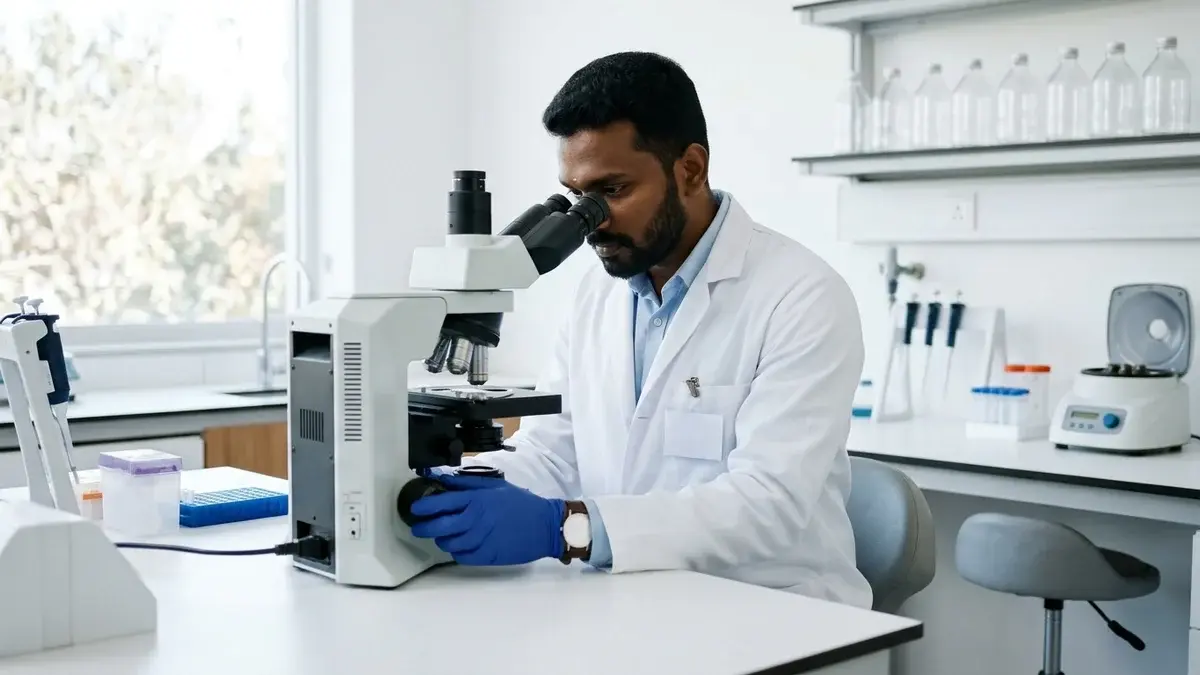

The AZF microdeletion test is a simple blood test that looks for small missing pieces in the part of the Y chromosome that controls sperm production, called the azoospermia factor (AZF) region. It is advised for men with no sperm in the semen (azoospermia) or a very low sperm count. The result tells your doctor how likely sperm retrieval is to succeed: men with an AZFc deletion often still have sperm that can be used for ICSI, while complete AZFa or AZFb deletions usually mean retrieval is unlikely. At Yaal Fertility Centre in Chennai, Dr. Rukkayal Fathima and our team use this result, alongside other tests, to plan the right next step with each couple.
What Is the AZF Microdeletion Test?
Every man has one X and one Y chromosome. The Y chromosome carries a cluster of genes needed to make sperm. These genes sit on the long arm of the Y chromosome, in an area known as the azoospermia factor (AZF) region.
A Y chromosome microdeletion means a small stretch of DNA in this region is missing. Because the missing piece is tiny, a standard chromosome test (karyotype) cannot see it under the microscope. The AZF test uses a molecular method called PCR (polymerase chain reaction), which checks for a set of DNA markers along the region. If a marker is absent, that section is reported as deleted.
Y chromosome microdeletions are one of the most common known genetic causes of severe male infertility, second only to Klinefelter syndrome. They do not cause symptoms in daily life. A man with a microdeletion usually looks and feels completely healthy, with normal sexual function. The only sign is a semen analysis that shows very few or no sperm.
The Three AZF Regions: AZFa, AZFb and AZFc
The AZF region is divided into three parts. Each controls a different stage of sperm production, which is why the location of a deletion matters so much.
| Region | What it controls | What a complete deletion usually means |
|---|---|---|
| AZFa | The earliest stage, the survival of the cells that become sperm | Testes contain no sperm-making cells at all ("Sertoli cell-only"); retrieval is very unlikely |
| AZFb | The middle stage, when early cells mature into sperm | Sperm production stops partway ("maturation arrest"); retrieval is very unlikely |
| AZFc | Later stages of sperm production | Production is reduced but often not absent; sperm are often found in semen or testis |
AZFc is by far the most commonly deleted region. Some men have deletions that cover more than one region, such as AZFb plus AZFc, and these behave like the more severe region involved.
How It Differs From Other Genetic Tests
| Test | What it looks at | Typical reason it is ordered |
|---|---|---|
| AZF microdeletion test | Tiny missing pieces of the Y chromosome | Azoospermia or very low sperm count |
| Karyotype | The number and structure of all 46 chromosomes | Same as above; also repeated miscarriage in either partner |
| CFTR gene test | Changes in the cystic fibrosis gene | Sperm tubes (vas deferens) missing on both sides |
| PGT on embryos | Chromosomes or specific genes in IVF embryos | Known genetic condition in the family; selected IVF cases |
The first three are blood tests on the man. Preimplantation genetic testing (PGT) is different: it is done on embryos during IVF.
Who Needs a Y Chromosome Microdeletion Test?
The test is not part of every fertility work-up. It is advised when the semen analysis points towards a sperm production problem in the testes.
Azoospermia
Azoospermia means no sperm are seen in the semen, even after the sample is spun down and examined closely. It comes in two broad types:
- Obstructive azoospermia: the testes make sperm, but a blockage stops them reaching the semen. AZF deletions are not the cause here.
- Non-obstructive azoospermia: the testes make few or no sperm. This is the group where AZF testing matters most.
Hormone levels, testicular size on examination and a scrotal scan help tell the two apart. Our guide to azoospermia treatment explains both types and how each is managed.
Very Low Sperm Count
Men with a very low sperm count (severe oligospermia), usually below about 5 million sperm per millilitre on repeated tests, are also advised to have the test. A single low result is not enough; counts vary, so most doctors repeat the semen analysis first. If you are unsure what your numbers mean, read our guide to the semen analysis report and normal sperm count range.
Before Sperm Retrieval or ICSI
The test is especially useful before surgical sperm retrieval such as TESA or micro-TESE. If a complete AZFa or AZFb deletion is found, surgery is very unlikely to find sperm, and the couple can be spared an operation. It is also useful before ICSI for a low sperm count, because a deletion can pass to sons.
When the Test Is Usually Not Needed
- Mildly low sperm count, low motility or abnormal shape alone.
- Obstructive azoospermia with a clear cause, such as a past vasectomy.
- Men whose low count is clearly explained by another cause, such as steroid use, though doctors may still test if the count stays very low after the cause is removed.
For an overview of the wider picture, see our guide to male infertility: azoospermia, oligospermia and varicocele.
How the AZF Test Is Done
The test is easy for the patient.
- Sample: a small blood sample from a vein in the arm.
- Preparation: no fasting is needed, and regular medicines can be taken as usual.
- Time: the blood draw takes a few minutes. The result usually comes back from the genetics laboratory within a couple of weeks; your doctor will tell you the expected time.
- One test for life: your genes do not change, so the test does not need repeating once a reliable result is available.
In the laboratory, DNA is taken from white blood cells and a panel of markers across AZFa, AZFb and AZFc is checked. Reputable laboratories follow European guidelines for which markers to test, so ask whether the panel is a standard one. Some laboratories also offer extended testing to look for partial deletions, especially in the AZFc region.
Understanding Your AZF Microdeletion Test Result
The report lists which markers were present and which were absent, then gives a summary. Your doctor will explain it, but here is what each common result usually means.
| Result | What it suggests | Usual next step |
|---|---|---|
| No deletion detected | The AZF region is intact; the cause lies elsewhere | Look for other causes: hormones, varicocele, other genetic factors, blockage |
| AZFc deletion | Sperm production is reduced but often not absent | Check semen again for any sperm; if none, micro-TESE is often reasonable, followed by ICSI |
| Complete AZFa deletion | No sperm-making cells in the testes | Retrieval is very unlikely; discuss donor sperm or other options |
| Complete AZFb deletion | Sperm production stops before sperm form | Retrieval is very unlikely; discuss donor sperm or other options |
| Combined deletions (for example AZFb plus AZFc) | Severe loss of sperm production | Retrieval is very unlikely in most cases |
| Partial deletion | Only part of a region is missing; effect varies | Individual counselling; may still allow sperm production |
A Normal Result
A normal result is good news in one sense: it rules out a Y chromosome deletion as the cause and means there is no deletion to pass to a son. It does not mean sperm will definitely be found. Many men with non-obstructive azoospermia have a normal AZF test, and the cause may be hormonal, linked to past mumps, undescended testes, cancer treatment or unknown factors. Your doctor will look at the full picture.
AZFc Deletion: Sperm Are Often Still Found
An isolated AZFc deletion is the most common and the most hopeful positive result. Many men with an AZFc deletion still make some sperm. In some, a few sperm appear in the semen, enough to use for ICSI without surgery. In men with no sperm in the semen, a careful micro-TESE often finds small areas of sperm production in the testes.
Sperm production with an AZFc deletion can decline over time. Some doctors therefore suggest freezing sperm while some are still present in the semen, so they are available for future treatment. Ask your doctor whether this applies to you.
Complete AZFa or AZFb Deletion: Retrieval Is Usually Unlikely
When the whole AZFa or AZFb region is missing, the testes usually lack the cells or the steps needed to make sperm. Published experience shows that surgical retrieval in these men almost never finds usable sperm. Most specialists advise against surgery in this situation.
This is hard news to hear. Its value is that it gives a clear answer early, without an operation that is very unlikely to help. Couples can then think about donor sperm, which is legally regulated in India, or other ways of building a family, at their own pace.
Partial Deletions
Sometimes only part of a region is missing. Partial AZFc deletions in particular are common in some populations and may cause anything from no effect to reduced sperm production. These results need a careful talk with your doctor, who will weigh them against your semen analysis, hormones and testicular examination.
What the Result Means for Sperm Retrieval
Sperm retrieval is a minor surgical procedure to collect sperm directly from the testis. The two main methods are:
- TESA (testicular sperm aspiration): a fine needle draws out small amounts of tissue. Quick, and often used in obstructive azoospermia.
- Micro-TESE (microdissection testicular sperm extraction): the surgeon uses an operating microscope to find the small tubules most likely to contain sperm. It is the preferred method for non-obstructive azoospermia.
Our article on TESA vs micro-TESE for azoospermia compares them in detail, and our TESA and micro-TESE treatment page explains how the procedure is planned.
The AZF result guides this choice:
- No deletion or AZFc deletion: retrieval can be considered, often by micro-TESE when there are no sperm in the semen.
- Complete AZFa, AZFb or combined deletion: retrieval is usually not recommended.
Hormone levels and testicular size help predict retrieval too, but none of them can promise a result in advance. Only the AZF result, when it shows a complete AZFa or AZFb deletion, gives a strong signal that surgery is unlikely to succeed.
ICSI When an AZF Deletion Is Present
When sperm are found, either in the semen or by retrieval, they are usually very few. Standard IVF needs thousands of moving sperm in a dish around each egg. ICSI (intracytoplasmic sperm injection) needs only one healthy sperm per egg, which an embryologist injects directly into the egg.
For men with an AZFc deletion, ICSI makes fatherhood possible in many cases. Fertilisation with these sperm is generally similar to other severe male-factor cases, though each couple's chances depend on the number and quality of sperm and on the woman's age and egg quality.
ICSI helps sperm and egg meet. It does not change the genes in the sperm, so the deletion is still present in the sperm used.
Will an AZF Deletion Pass to Our Children?
This is one of the most important questions to discuss before treatment.
Sons
A son always gets his Y chromosome from his father. If a man with an AZF deletion fathers a son with his own sperm, through ICSI or naturally, the son will inherit the same Y chromosome deletion. He is likely to have fertility problems of his own as an adult, which may be similar to, or sometimes more severe than, his father's. His general health is otherwise expected to be normal.
Daughters
A daughter gets her father's X chromosome, not his Y. Daughters therefore do not inherit the deletion, are not affected by it and cannot pass it on.
Thinking It Through as a Couple
Some couples are comfortable knowing that a future son may need fertility help, especially since treatments continue to improve. Others prefer to consider donor sperm. There is no single right answer. Choosing a baby's sex is strictly regulated in India and is not offered for this reason, so this is a question of informed decision-making rather than selection, and a genetic counsellor can help you work through it.
Tests Done Alongside the AZF Test
AZF testing is one part of a full evaluation for azoospermia or a very low count. Your doctor will usually also arrange:
- Karyotype: checks all chromosomes. It picks up conditions such as Klinefelter syndrome, where a man has an extra X chromosome (47,XXY), and structural changes such as translocations. Karyotype and AZF testing are often done together on the same visit.
- Hormone tests: FSH, LH, testosterone and sometimes prolactin. A high FSH usually points to a sperm production problem in the testes; low hormones point to a problem in the brain's signals, which can sometimes be treated with medicines.
- Scrotal ultrasound: measures testicular size and checks for varicocele, blockages or other changes.
- CFTR gene test: for men in whom the sperm tubes (vas deferens) cannot be felt on both sides, a condition linked to changes in the cystic fibrosis gene. If positive, the female partner is usually tested too.
- Repeat semen analysis, sometimes with a careful search of the spun-down sample for even a few sperm.
Together, these results let your doctor separate blockage from production problems, find treatable causes and give a realistic view of your options.
Genetic Counselling Before Treatment
A positive AZF result raises questions that go beyond the next procedure. Good counselling covers:
- What the result means for your chances of finding sperm, in plain words.
- What it means for future children, especially sons.
- Your options: ICSI with your own sperm, freezing sperm early, donor sperm, or other ways to build a family.
- The emotional side: many men feel shock, guilt or a sense of loss after this result. These feelings are common and valid, and talking them through helps.
In many Indian families, fertility problems are wrongly blamed on the woman. An AZF result can shift this, and it can also put pressure on the man. A clear explanation, shared by both partners together, helps a couple support each other and make decisions as a team rather than under family pressure.
Common Questions Couples in Chennai Ask Us
"Did I cause this?" No. Y chromosome microdeletions happen in the sperm-making genes before birth, often as a new change that neither parent had. Lifestyle, diet and past habits did not cause them.
"Can medicines or diet fix it?" No medicine, supplement, diet or surgery can restore missing genes. Staying healthy still supports whatever sperm production you have, but it will not reverse a deletion.
"Should my brother be tested?" If your deletion was inherited from your father, your brothers will carry it too. This is worth discussing with your doctor, especially if a brother is also trying for a family.
"Does it affect my health?" An isolated AZF deletion affects sperm production only. It does not affect strength, sexual function, life expectancy or general health.
Frequently Asked Questions About the AZF Microdeletion Test
What is the AZF microdeletion test?
It is a blood test that checks the Y chromosome for small missing pieces in the AZFa, AZFb and AZFc regions, which control sperm production. It is advised for men with azoospermia or a very low sperm count.
Do I need to fast before the Y chromosome microdeletion test?
No. The test reads your DNA from a blood sample, so food, drink and regular medicines do not affect it.
What is the difference between a karyotype and an AZF test?
A karyotype looks at the number and shape of all chromosomes under a microscope and finds conditions like Klinefelter syndrome. The AZF test uses PCR to find tiny Y chromosome deletions that are too small to see on a karyotype, so the two are often done together.
Can sperm be found with an AZFc deletion?
Often, yes. Many men with an isolated AZFc deletion have a few sperm in the semen or in the testes, which can be used for ICSI.
Is sperm retrieval worth trying with an AZFa or AZFb deletion?
With a complete AZFa or AZFb deletion, retrieval almost never finds usable sperm, so most specialists advise against surgery. Your doctor will discuss donor sperm and other options.
Will my son inherit an AZF microdeletion?
Yes. A son conceived with your sperm inherits your Y chromosome and the same deletion, and may face fertility problems as an adult. Daughters do not inherit it.
Can an AZF microdeletion be treated?
The deletion itself cannot be reversed by medicine or surgery. Treatment focuses on finding any available sperm for ICSI, or on other family-building options.
Where can I get an AZF microdeletion test in Chennai?
Your fertility specialist arranges the blood test through a molecular genetics laboratory as part of a male fertility work-up. At Yaal Fertility Centre, our team can advise whether you need it and explain the result with you.
Male Infertility Care at Yaal Fertility Centre, Chennai
At Yaal Fertility Centre, our male infertility team led by Dr. Rukkayal Fathima, MRCOG (UK) starts with a careful semen analysis and examination, then advises AZF and karyotype testing only when your results call for it. We go through the report with you and your partner together, explain in plain words what it means for sperm retrieval and for future children, and help you choose between ICSI, sperm freezing, donor options and other paths without pressure.
You can see our team at any of our eight centres across Chennai: Kilpauk, Mylapore, Thiruvanmiyur, Pallikaranai, Madipakkam, Red Hills, Velappanchavadi and Tambaram.
If a semen analysis has shown no sperm or a very low count, or you have been advised an AZF microdeletion test, book a consultation with Yaal Fertility Centre.
Written by
Dr. Rukkayal Fathima
Specialist at Yaal Fertility Centre, Chennai. Providing expert guidance on fertility and women's health.