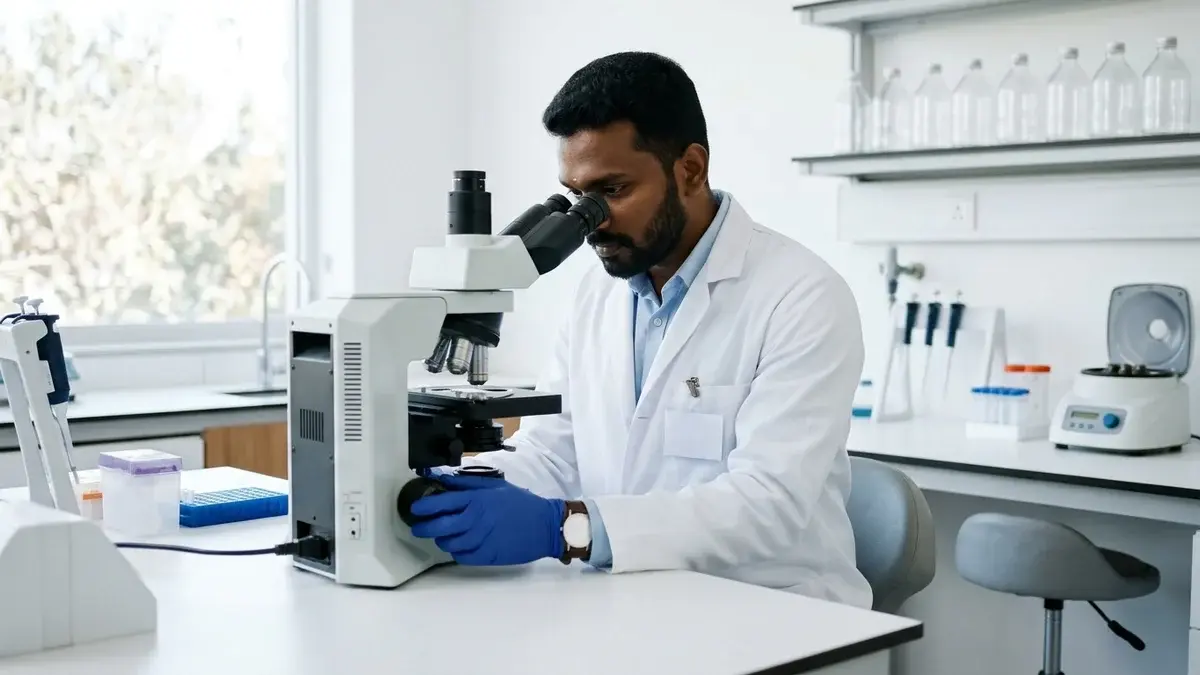

Klinefelter syndrome is a chromosome condition in which a man is born with an extra X chromosome, so his cells carry 47,XXY instead of the usual 46,XY. It is one of the most common genetic causes of male infertility, and many men only find out about it in their late twenties or thirties, when a semen test shows no sperm. The good news is that a diagnosis does not always rule out a biological child: with micro-TESE (microscopic sperm retrieval) and ICSI, sperm can be found in a good share of men. At Yaal Fertility Centre in Chennai, Dr. Rukkayal Fathima and our team help couples understand the diagnosis and plan the next step calmly.
What Is Klinefelter Syndrome (47,XXY)?
Most people have 46 chromosomes in each cell: 22 pairs plus two sex chromosomes. Men usually have one X and one Y (46,XY). In Klinefelter syndrome, there is one extra X, giving 47 chromosomes in total (47,XXY).
The Y chromosome still makes the baby male. But the extra X affects how the testes develop, especially from puberty onwards. Over time the tiny tubes inside the testes, where sperm are made, become scarred. The testes stay small and produce less testosterone.
Klinefelter syndrome is common. It is estimated to affect roughly 1 in 500 to 1 in 1,000 boys. Yet most men with it are never diagnosed, or are diagnosed only as adults, because the signs can be very mild.
How the Extra X Chromosome Happens
The extra X comes from a random error when the egg or the sperm is formed, before the pregnancy begins. Chromosomes are meant to split evenly into the egg or sperm. Sometimes a pair does not separate, so one egg or sperm carries an extra X.
This is chance. Nothing the parents ate, did or failed to do caused it. It is not caused by anything the man himself did either. Parents sometimes carry guilt about this, and it helps to hear clearly that it is nobody's fault.
Classic and Mosaic Klinefelter Syndrome
Most men have the classic form, in which every cell carries 47,XXY.
A smaller group has mosaic Klinefelter syndrome. Here the error happens after conception, so some cells are 46,XY and others are 47,XXY. Men with the mosaic form often have milder features and may have better testicular function. A few even have small numbers of sperm in their semen.
There are also rarer variants with more than one extra X (such as 48,XXXY). These usually have more pronounced features and are managed by specialist teams.
Klinefelter Syndrome Symptoms at Different Ages
The signs of Klinefelter syndrome vary a great deal from one person to another. Some boys show clear features in childhood. Many men have so few signs that nobody suspects anything until they try for a baby.
Babies and Young Children
In babies, signs are usually subtle or absent. Some have slightly low muscle tone, or the testes may not have come down into the scrotum at birth.
In young children, parents and teachers may notice:
- slightly late sitting, walking or talking
- speech and language difficulties
- reading or learning challenges
- a quiet, shy temperament or difficulty with attention
None of these are specific to Klinefelter syndrome, which is one reason it is rarely picked up in childhood.
Teenage Years and Puberty
Puberty is when the effects of the extra X often become clearer, because the testes cannot keep up with the body's need for testosterone. Signs can include:
- being taller than expected for the family, with longer legs and arms
- less facial and body hair than friends
- small, firm testes
- less muscle bulk
- some breast development (gynaecomastia)
- puberty that starts normally but does not fully progress
Many teenage boys have one or two of these features without any chromosome problem, so they are a reason to see a doctor, not a diagnosis.
Adult Men
In adults, the most common reason Klinefelter syndrome is found is infertility. A couple has been trying for a year or more, the man gives a semen sample, and the report shows azoospermia (no sperm at all) or a very low count.
Other adult signs can include low energy, low sex drive, reduced muscle strength, small testes and, in some men, weaker bones. Many men have a normal sex life and look entirely healthy. In Chennai, we often meet men who are surprised by the diagnosis because they have never had a health problem.
How Is Klinefelter Syndrome Diagnosed?
The path to a diagnosis in adults usually starts with a semen test and ends with a simple blood test that counts the chromosomes.
Semen Analysis
A semen analysis is often the first clue. Most men with classic Klinefelter syndrome have no sperm in the sample. The test is normally repeated to confirm the result, and the lab will spin the sample down to check carefully for even a few sperm.
Hormone Tests
Blood tests for hormones help show where the problem lies:
| Hormone | Usual pattern in Klinefelter syndrome | What it means |
|---|---|---|
| FSH | High | The brain is pushing hard for sperm production that the testes cannot deliver |
| LH | High | The brain is pushing the testes to make more testosterone |
| Testosterone | Low or low-normal | The testes are not making enough |
High FSH and LH with low or borderline testosterone is called primary testicular failure. It points to the testes themselves rather than the brain's signals. You can read more about this in our guide to low testosterone and fertility.
Karyotype: The Confirming Test
A karyotype is a blood test that looks at all the chromosomes under a microscope. Finding 47 chromosomes with two Xs and a Y confirms Klinefelter syndrome. It also shows whether the pattern is classic or mosaic.
When a man has no sperm and high FSH, guidelines advise a karyotype alongside a Y chromosome microdeletion (AZF) test. The two tests look for different things, and together they help predict whether sperm retrieval is likely to work. Both are part of genetic testing for male infertility.
Health Aspects Beyond Fertility
Klinefelter syndrome is mainly a fertility and hormone condition, but low testosterone over many years can affect general health. This is a brief overview; your doctor or an endocrinologist will tailor care to you.
Testosterone
Testosterone supports energy, mood, muscle, bone strength and sex drive. Many men with Klinefelter syndrome have low levels and feel better on testosterone replacement. It is usually started by an endocrinologist.
Bones
Low testosterone can thin the bones over time (osteopenia or osteoporosis). Your doctor may suggest a bone density scan, weight-bearing exercise, and enough calcium and vitamin D from diet or supplements.
Metabolism and Heart Health
Men with Klinefelter syndrome have a higher chance of belly fat, insulin resistance, type 2 diabetes and high cholesterol. Regular checks of sugar, weight and lipids, along with an active lifestyle, help keep these in check.
Mood and Learning
Some men have had learning or attention difficulties in school, and some experience anxiety or low mood. These are worth talking about openly, as support helps.
Klinefelter Syndrome and Fertility: Can Men With 47,XXY Have Children?
For many years, Klinefelter syndrome was thought to mean a man could never be a biological father. That is no longer true. Many men can now have their own genetic child with help.
Why Azoospermia Is So Common
Most men with classic Klinefelter syndrome have non-obstructive azoospermia. This means there is no blockage; the testes simply make very little sperm. From puberty, the sperm-making tubes gradually scar and lose the cells that make sperm.
Our article on azoospermia treatment explains the difference between blocked and non-blocked azoospermia in more detail.
Small Pockets of Sperm Production
The scarring is rarely even. Inside the testes, there are often small pockets of healthier tubes where sperm are still being made. They are too few for sperm to reach the semen, but a skilled surgeon can sometimes find them directly in the testicle.
This is the basis of modern fertility treatment for men with Klinefelter syndrome.
Fertility Treatment: Micro-TESE With ICSI
When a man with Klinefelter syndrome has no sperm in his semen, the usual route to a biological child is to retrieve sperm from the testes and use them with ICSI.
What Micro-TESE Involves
Micro-TESE (microdissection testicular sperm extraction) is done under anaesthesia. The surgeon opens the testis and uses an operating microscope to look for the plumper, healthier tubes that are more likely to hold sperm. Small pieces are removed and examined in the lab straight away.
Micro-TESE is generally preferred over a simple needle aspiration (TESA) in Klinefelter syndrome because sperm are found only in small, scattered areas. Our comparison of TESA and micro-TESE explains how the two differ, and our TESA and micro-TESE treatment page covers what to expect on the day.
How Often Is Sperm Found?
Published studies report that sperm are found in roughly four to six out of every ten men with Klinefelter syndrome who have micro-TESE. Results vary between studies and between men. Factors that may matter include age, hormone levels, whether the man has already taken testosterone, and the surgeon's experience.
It is important to go in with honest expectations: some men will have sperm found, and some will not. Your doctor will talk through your own chances before you decide.
ICSI: Using the Sperm That Are Found
Micro-TESE usually finds only a small number of sperm. That is enough for ICSI, where an embryologist injects a single sperm into each egg. The fertilised eggs grow into embryos in the lab, and one is placed in the womb.
Sperm can be used in a fresh ICSI cycle on the same day as retrieval, or frozen for later. Your team will plan the timing with the female partner's IVF cycle. You can read more on our male infertility treatment page.
Timing Matters
Because sperm-making tissue tends to decline with age, many specialists suggest not delaying evaluation once the diagnosis is known and the couple wants a child. This does not mean rushing into surgery, but it is a reason to see a fertility specialist early rather than waiting for years.
Testosterone Therapy and Fertility
This is one of the most important points for men with Klinefelter syndrome. Testosterone tablets, gels or injections taken from outside switch off the brain's signals to the testes, and that can stop whatever little sperm production remains.
So if you hope to have a biological child, talk to a fertility specialist before starting testosterone, or before planning sperm retrieval if you are already on it. Your doctor may advise pausing it for a while or using other medicines to support your own hormones before micro-TESE. Never stop or change any hormone treatment on your own.
Sperm Freezing for Teenagers and Young Men
Some teenage boys and young men with Klinefelter syndrome still have a few sperm in their semen before the decline progresses. When the diagnosis is made early, doctors may offer:
- a semen test in late adolescence or early adulthood
- sperm freezing if any sperm are seen, so they are saved for the future without surgery
- discussion of whether testicular sperm retrieval for freezing makes sense, if no sperm are in the semen
This is a sensitive conversation that involves the young man, his family, an endocrinologist and a fertility specialist. The aim is to keep future choices open without pressure.
Genetic Counselling and Your Children's Health
Couples naturally ask whether a child conceived with sperm from a man with Klinefelter syndrome will have the condition too.
What Is the Risk?
Most sperm found by micro-TESE in men with Klinefelter syndrome carry a normal set of chromosomes, and most children born this way have normal chromosomes. Studies suggest a slightly higher chance of chromosome differences in embryos, so it is worth discussing.
Genetic counselling before treatment helps you understand these risks in plain words and decide on any testing during pregnancy or of embryos.
Testing Embryos
Some couples choose preimplantation genetic testing (PGT-A), where a few cells from each embryo are tested for the number of chromosomes before transfer. It is optional and has its own pros and limits, which your team will explain. Others choose standard tests during pregnancy instead.
If No Sperm Is Found: Other Paths to Parenthood
If micro-TESE does not find sperm, it is a hard moment, and it is normal to need time. Couples still have options:
- Donor sperm: Screened donor sperm can be used with IUI or IVF. The female partner carries the pregnancy, and the child is genetically hers. Our donor programs page explains how this works and the legal safeguards in India.
- Adoption: A meaningful path to parenthood for many families.
- Pause and reflect: Some couples take time before deciding, and counselling helps.
Some couples decide in advance to have donor sperm ready as a back-up on the day of micro-TESE, so the female partner's IVF cycle is not wasted if no sperm are found. This is a personal choice and should be discussed well before treatment.
When to See a Fertility Specialist
Consider an evaluation if:
- a semen test has shown no sperm or a very low count
- you have been trying for a year without pregnancy (six months if the female partner is over 35)
- you have small testes, little body hair or breast development, along with fertility worries
- a doctor has already found high FSH or low testosterone
- your son has been diagnosed with Klinefelter syndrome and is approaching his late teens
Bring any past semen reports, hormone results and scans to your first visit. Your doctor will usually examine you, repeat key tests and arrange a karyotype if it has not been done.
Frequently Asked Questions About Klinefelter Syndrome
Can a man with Klinefelter syndrome get his wife pregnant naturally?
It is very rare with the classic form, because most men have no sperm in their semen. Men with the mosaic form occasionally have some sperm, and micro-TESE with ICSI is the usual route for others.
Is Klinefelter syndrome inherited?
Usually not. It happens by chance when the egg or sperm is formed, and parents of a boy with Klinefelter syndrome have a low chance of it happening again.
Does testosterone treatment improve sperm count in Klinefelter syndrome?
No. Testosterone taken from outside lowers sperm production further, so men who want children should see a fertility specialist before starting or continuing it.
What is the success rate of micro-TESE in Klinefelter syndrome?
Studies report that sperm are found in roughly four to six out of ten men, though this varies with age, hormone history and surgical experience. Your specialist will discuss your own chances.
Will my child have Klinefelter syndrome?
Most children conceived with sperm from men with Klinefelter syndrome have normal chromosomes. Genetic counselling helps you weigh the small added risk and any testing options.
How is Klinefelter syndrome confirmed?
A karyotype blood test confirms it by showing 47 chromosomes with an extra X. Hormone tests and a semen analysis usually come first.
Is Klinefelter syndrome the same as low testosterone?
No. Klinefelter syndrome is a chromosome condition that often causes low testosterone, but many men have low testosterone for other reasons.
Klinefelter Syndrome Care at Yaal Fertility Centre, Chennai
At Yaal Fertility Centre, Dr. Rukkayal Fathima, MRCOG (UK) and our male infertility team help couples make sense of a Klinefelter syndrome diagnosis, from confirming it with the right tests to planning sperm retrieval, ICSI, genetic counselling or donor options. We explain each step clearly and look after both partners together.
You can see our team at any of our eight centres across Chennai: Kilpauk, Mylapore, Thiruvanmiyur, Pallikaranai, Madipakkam, Red Hills, Velappanchavadi and Tambaram.
If a semen test has shown no sperm, or you have been told you have 47,XXY, book a consultation with Yaal Fertility Centre.
Written by
Dr. Rukkayal Fathima
Specialist at Yaal Fertility Centre, Chennai. Providing expert guidance on fertility and women's health.