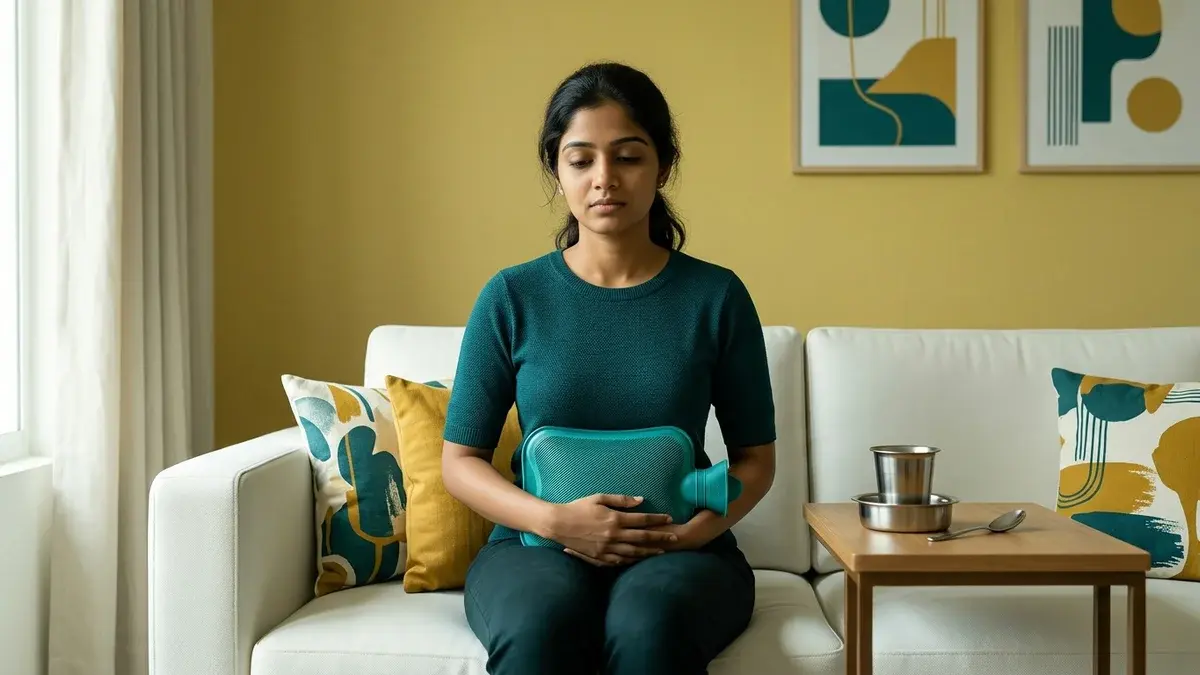

Period blood clots are common, and small ones on your heaviest days are usually normal. They form when blood collects in the womb faster than the body's natural clot-dissolving substances can thin it. Clots larger than about 2.5 cm (roughly a ₹10 coin), clots in most periods, or bleeding that soaks a pad every hour or two are signs of heavy bleeding that should be checked, because the cause is often treatable and heavy periods lead to anaemia. At Yaal Fertility Centre in Chennai, Dr. Rukkayal Fathima and our team see many women with heavy periods and clots, and this guide explains what is normal, what causes larger clots and what to do about them.
What Are Period Blood Clots?
Menstrual blood clots are soft, jelly-like lumps of blood mixed with bits of the womb lining. They are usually dark red or almost black, and they may look like small pieces of liver or jelly on your pad.
They are not pieces of the baby, the womb or anything dangerous in themselves. They are simply blood that has thickened before leaving the body.
Why Clots Form During a Period
Every month, the lining of the womb (endometrium) builds up and then sheds as your period. As it sheds, small blood vessels open and bleed into the womb.
Your body has two systems working at once:
- Clotting, which stops vessels bleeding too much.
- Natural clot-dissolvers released by the lining, which keep period blood runny so it can flow out through the narrow cervix.
On light days, the dissolvers keep up, so blood comes out liquid. On heavy days, blood pools in the womb or vagina faster than they can work, so some of it thickens into clots. That is why clots usually appear on the first one or two days, or first thing in the morning after blood has collected while you were lying down.
Is It a Clot or Tissue?
Clots are soft and break apart when pressed. Firmer, greyish or pinkish tissue, especially with cramping and a positive or possible pregnancy, can be a sign of miscarriage and needs a doctor the same day.
Are Period Blood Clots Normal?
Most women pass small clots now and then. What matters is the size, how often you see them and how heavy the bleeding is overall.
Normal Clots and Clots That Need Checking
| Usually normal | Get it checked | |
|---|---|---|
| Size | Smaller than about 2.5 cm (smaller than a ₹10 coin) | Larger than about 2.5 cm |
| How often | Now and then, on the heaviest one or two days | Most periods, or throughout the period |
| Pad changes | Every 3 to 4 hours or longer | Soaking a pad every hour or two, or needing two pads together |
| At night | You sleep through | You wake to change pads or stain the bed |
| Length of period | Up to 7 days | Longer than 7 days |
| How you feel | Normal energy | Tired, breathless, dizzy |
If you tick even one box in the right-hand column regularly, it is worth a visit. Heavy bleeding is so common in India that many women assume it is just how their periods are, but it often has a treatable cause.
What Clot Colour Tells You
- Bright red: fresh, fast-flowing blood, typical of heavy days.
- Dark red or almost black: blood that has sat in the womb a little longer before coming out. Common in the morning.
- Brown: older blood, often at the start or end of a period.
Colour on its own is rarely a sign of disease. Size, frequency and heaviness tell your doctor much more.
Heavy Periods With Clots: What Counts as Heavy?
Doctors describe heavy menstrual bleeding as bleeding that is heavy enough to affect your daily life, work, sleep or energy. You do not need to measure blood loss exactly. These are the usual signs:
- Changing pads every hour or two on more than one day.
- Using two pads together, or pads and a cloth, to avoid leaks.
- Passing clots larger than about 2.5 cm.
- Bleeding through clothes or bedsheets.
- Avoiding work, college or travel during periods.
- Periods that last more than 7 days.
Heavy Bleeding Is Often Hidden
Many women in Chennai carry spare clothes, stay home on the first day or plan family functions around their periods without thinking of it as a medical problem. If you are planning your life around your periods, they are heavy enough to talk to a doctor about.
What Causes Large Blood Clots During a Period?
Large clots almost always come from heavy bleeding, so the question is what is making the bleeding heavy. Often there is more than one reason.
| Cause | How it leads to clots | Typical clues |
|---|---|---|
| Fibroids | Bigger lining surface and a womb that cannot squeeze shut properly | Heavy periods, pressure, lump on scan |
| Adenomyosis | Lining tissue in the muscle makes the womb bulky and bleed more | Painful, heavy periods, bulky womb |
| Endometrial polyps | Soft growths of the lining that bleed easily | Bleeding between periods, heavier periods |
| Hormone imbalance | Lining builds up for weeks without ovulation, then sheds heavily | Irregular periods, PCOS, teens and 40s |
| Thyroid problems | Underactive thyroid can make periods heavier | Tiredness, weight gain, feeling cold |
| Early miscarriage | Pregnancy loss can look like a heavy, late period | Late period, cramps, tissue |
| Bleeding disorders | Blood does not clot normally, so periods are heavy | Heavy periods since teens, easy bruising, nosebleeds |
| Medicines and devices | Blood thinners or a copper IUD can increase flow | Change after starting the medicine or device |
Fibroids
Fibroids are non-cancerous lumps of muscle in the womb. Those that bulge into the cavity (submucosal fibroids) are most likely to cause heavy bleeding and clots, even when small. Larger fibroids in the wall can also make periods heavier by stretching the cavity. Our guide to uterine fibroids explains the types and treatments.
Adenomyosis
In adenomyosis, tissue like the lining grows into the muscle wall. The womb becomes enlarged and tender, and periods become heavy and painful, often worsening through the 30s and 40s. See adenomyosis for how it is diagnosed and treated.
A Bulky Uterus
A scan report may say "bulky uterus", which means the womb is larger than expected. A bigger womb has a bigger lining to shed, and the most common reasons, fibroids and adenomyosis, both cause heavy bleeding. Read more about a bulky uterus.
Polyps and a Thick Lining
Polyps are soft growths of the lining. They often cause spotting between periods as well as heavier flow. A lining that has grown too thick, for example after months without ovulation, can also shed heavily with clots. See uterine polyps and thick endometrium.
Hormonal Causes and Irregular Cycles
When you do not ovulate, the ovaries keep making estrogen, which builds the lining, but little progesterone, which normally helps it shed in an orderly way. The lining keeps thickening, and when it finally sheds, bleeding can be very heavy, with large clots. This is common:
- In the first few years after periods start.
- With PCOS.
- In the years before menopause (perimenopause).
- With large weight changes or stress.
If your periods are both heavy and irregular, see our guide to irregular periods.
Thyroid Problems
An underactive thyroid can make periods heavier and longer. A simple blood test checks for it, and treating the thyroid often improves periods. Read about thyroid and fertility.
Miscarriage
A very early miscarriage can look like a late, heavy period with clots and stronger cramps. If there is any chance you could be pregnant, take a pregnancy test and see a doctor. Heavy bleeding with one-sided pain in early pregnancy can also be a sign of an ectopic pregnancy, which is an emergency.
Bleeding Disorders
Some women inherit a tendency to bleed more, such as von Willebrand disease. It is under-diagnosed. Suspect it if periods have been very heavy since your first period, you bruise easily, have frequent nosebleeds or bleeding gums, bled heavily after childbirth or a tooth extraction, or close family members have similar problems.
Heavy Periods, Clots and Anaemia
Heavy periods slowly drain your iron. Iron is needed to make haemoglobin, which carries oxygen in the blood. When you lose more each month than you take in, you develop iron deficiency anaemia. Anaemia is very common in Indian women, and heavy periods are one of its most common causes.
Signs of Anaemia
- Tiredness that does not improve with sleep.
- Breathlessness or a racing heart when climbing stairs.
- Pale skin, pale inner eyelids or pale nails.
- Dizziness or feeling faint when you stand up.
- Hair fall.
- Headaches and poor concentration.
- Brittle nails or nails that curve upward.
- Craving ice, raw rice, chalk or mud.
Iron stores can be low long before haemoglobin drops, so you may feel tired even when a basic blood count is "normal". Your doctor may check ferritin, which measures stored iron.
Anaemia and Pregnancy
If you are planning a pregnancy, it is best to correct anaemia before you conceive, because pregnancy needs a lot of extra iron. Preconception care includes checking and building up your iron.
How Doctors Find the Cause
Your History
Your doctor will ask how long your periods last, how often you change pads, how big the clots are, whether you wake at night to change, whether periods are painful or irregular, and about bruising, nosebleeds and family history. A period diary for two or three months makes this much easier.
Examination
A gentle tummy and pelvic examination checks the size and shape of the womb and the cervix.
Blood Tests
- Complete blood count (CBC) for haemoglobin and anaemia.
- Ferritin for stored iron.
- Thyroid function (TSH).
- Pregnancy test if there is any chance of pregnancy.
- Clotting tests, including for von Willebrand disease, when the history suggests a bleeding disorder.
- Hormone tests when periods are irregular.
Ultrasound
A pelvic scan, usually transvaginal, shows fibroids, adenomyosis, polyps and the thickness of the lining. It is quick and painless for most women. Our ultrasound services team does these scans. For help reading your report, see our guide to uterus size and position on a scan.
Hysteroscopy and Biopsy
If a polyp, a fibroid inside the cavity or an unusual lining is suspected, a hysteroscopy lets the doctor look inside the womb with a thin camera and often remove the problem at the same time. A small sample of the lining (biopsy) may be taken, especially in women over 40 or with bleeding between periods.
Treatment for Heavy Periods and Clots
Treatment depends on the cause, how much the bleeding affects you and whether you want a pregnancy now or later. Your doctor will explain which options suit you, along with their side effects.
Medicines Taken During Your Period
- Non-hormonal medicines that help blood clot normally in the womb can reduce bleeding a lot. They are taken only on heavy days.
- Anti-inflammatory painkillers can reduce both bleeding and cramps.
Both can be used while trying to conceive. Ask your doctor which is right for you, and do not start any medicine without advice.
Hormonal Treatments
- A hormonal coil (IUD) placed in the womb thins the lining and greatly reduces bleeding for most women. It lasts several years but is not suitable while you are trying to conceive.
- The combined pill lightens and regulates periods.
- Progestogen tablets help the lining shed regularly, useful with irregular cycles and PCOS.
Iron
If you are anaemic, your doctor will prescribe iron tablets, or an iron infusion if levels are very low or tablets are not tolerated. Food alone rarely corrects established anaemia, but it helps keep levels up.
Treating the Cause
- Polyps or fibroids inside the cavity can be removed by hysteroscopy, through the vagina with no cuts.
- Larger fibroids may be removed by myomectomy, often by laparoscopic surgery.
- Thyroid problems are treated with thyroid medicine.
- Bleeding disorders are managed with a blood specialist.
When Family Is Complete
For women who have finished their families and still have heavy bleeding despite other treatment, options include a procedure to remove the lining or, as a last option, hysterectomy. These are never the first step.
Iron-Rich South Indian Foods for Heavy Periods
Our everyday South Indian kitchen has many good sources of iron.
Plant Sources
- Ragi (finger millet): as kanji, dosa, adai or ragi balls.
- Murungai keerai (drumstick leaves): in poriyal, adai or dal.
- Other keerai: mulai keerai, arai keerai, siru keerai and palak.
- Kollu (horse gram): as rasam, sundal or thuvaiyal.
- Pulses: toor dal, chana, rajma, green gram and black-eyed beans.
- Ellu (sesame): ellu urundai or podi.
- Dates and jaggery in moderation, especially if you have diabetes.
Animal Sources
If you eat them, eggs, fish, chicken, mutton and liver contain a form of iron the body absorbs more easily than iron from plants.
Help Your Body Absorb Iron
- Add lemon, amla, tomato, guava or orange to iron-rich meals. Vitamin C helps the body take up plant iron.
- Keep tea and coffee at least an hour away from meals, since they reduce iron absorption.
- Cooking in an iron kadai adds a little iron to food.
A Simple Day of Iron-Rich Eating
| Meal | Example |
|---|---|
| Breakfast | Ragi dosa with tomato chutney, guava |
| Lunch | Rice with keerai kootu, kollu rasam and a squeeze of lemon |
| Evening | Ellu urundai or a few dates, no tea with it |
| Dinner | Chapati with chana masala, or fish curry, and an amla |
Diet supports recovery, but it does not stop heavy bleeding. If your periods are heavy, finding the cause matters more than any food.
When Period Clots Are an Emergency
Go to a hospital emergency department or see a doctor urgently if:
- You soak through one or more pads every hour for two or more hours in a row.
- You feel faint, very dizzy, short of breath, or your heart is racing.
- You pass very large clots along with feeling weak or unwell.
- You have severe tummy or pelvic pain that does not settle.
- You are pregnant or might be pregnant and have bleeding with clots or tissue, especially with one-sided pain or shoulder-tip pain.
- You have bleeding after menopause, which always needs a prompt check, though it is not usually an emergency.
How to Track Your Periods and Clots
A record of two or three periods helps your doctor understand your bleeding quickly.
What to Write Down
- Dates: the first and last day of each period.
- Pads: how many each day, and whether they were fully soaked.
- Clots: roughly how big (pea, ₹1 coin, ₹10 coin, larger) and on which days.
- Night-time: whether you had to wake up to change.
- Pain: how bad on a scale of 1 to 10, and whether painkillers helped.
- Other symptoms: tiredness, dizziness, bleeding between periods.
A phone period app or a notebook both work. Our guide to period pain relief also covers when cramps with heavy periods need checking.
Myths About Period Blood Clots
| Myth | Fact |
|---|---|
| Clots mean your body is getting rid of "bad blood" | Clots are just thickened period blood; they are not a cleanse |
| Heavy periods with clots are normal for some families | They may run in families because of fibroids or bleeding disorders, which can be treated |
| Clots mean cancer | Most clots are caused by benign problems; bleeding after menopause does need checking |
| Clots mean you cannot get pregnant | Clots themselves do not affect fertility, though some causes, like fibroids inside the cavity, can |
| Eating more iron-rich food will stop heavy periods | Food helps replace iron but does not reduce bleeding |
Frequently Asked Questions About Period Blood Clots
Are blood clots during periods normal?
Small clots on your heaviest one or two days are usually normal. Frequent clots, clots larger than about 2.5 cm or very heavy bleeding should be checked by a doctor.
What size of period clot is too big?
Clots larger than about 2.5 cm, roughly the size of a ₹10 coin, are a sign of heavy bleeding. Large clots in most periods need a check-up.
Why am I suddenly passing large clots during my period?
A sudden change can come from a fibroid or polyp, a hormonal change such as a missed ovulation or perimenopause, a thyroid problem, or an early miscarriage. If you could be pregnant, take a test and see a doctor.
Can fibroids cause period blood clots?
Yes. Fibroids, especially those bulging into the womb cavity, are one of the most common causes of heavy periods with clots.
Can heavy periods with clots cause anaemia?
Yes. Losing a lot of blood each month drains iron, which can cause tiredness, breathlessness, pale skin and hair fall. A blood count and ferritin test check for it.
Do period clots affect fertility?
Clots themselves do not. Some causes of heavy periods, such as fibroids inside the cavity, polyps or adenomyosis, can affect conception and are worth treating if you are trying for a baby.
What foods help with heavy periods and clots?
Iron-rich foods such as ragi, murungai keerai, kollu, dal, sesame, eggs and fish help replace lost iron, especially with lemon or amla. They do not reduce bleeding, so the cause still needs attention.
When should I go to the hospital for period clots?
Go urgently if you soak a pad every hour for two or more hours, feel faint or breathless, have severe pain, or bleed with clots while pregnant or possibly pregnant.
Heavy Period Care at Yaal Fertility Centre, Chennai
At Yaal Fertility Centre, our gynaecology team led by Dr. Rukkayal Fathima, MRCOG (UK) looks for the reason behind heavy periods and clots, checks for anaemia and explains each treatment option in plain words. We keep your plans for a family in mind, so treatment that protects your fertility comes first when that matters to you.
You can see our team at any of our eight centres across Chennai: Kilpauk, Mylapore, Thiruvanmiyur, Pallikaranai, Madipakkam, Red Hills, Velappanchavadi and Tambaram.
If heavy periods or clots are affecting your life, book a consultation with Yaal Fertility Centre.
Written by
Dr. Rukkayal Fathima
Specialist at Yaal Fertility Centre, Chennai. Providing expert guidance on fertility and women's health.